
Terner Labs Home
Housing Policy Simulator
Methodology
housing policy simulator
building tools for better decisions
Communities nationwide are facing a growing housing affordability crisis. We know building more homes is part of the solution, and pro-housing policies (like upzoning and limiting parking requirements) are gaining momentum in cities and states around the country. But how do we know which of these will actually work?
We created this tool - the Housing Policy Simulator - to model how specific policies are likely to play out in a given city. The map you see below is a simplified, user-friendly visualization of the Simulator, created to allow people to explore for themselves how different policies might play out in different cities.
About the Housing Policy Simulator
The Housing Policy Simulator ("Simulator") takes into consideration local economic conditions, zoning rules, historical development patterns, and "development math" (the calculations developers use to determine if a project makes sense). Based on these inputs, it estimates the likelihood of a developer building multi-family market-rate housing on a given piece of land, and calculates how this might change if a specific policy were applied.
How is this data used?
The Simulator provides crucial information about the possible impact of new policies, but it’s intended as just one input into the policymaking process. It doesn’t take into account who already lives in the communities being analyzed, or the non-monetary value (for example, historic or cultural importance) of what already exists on parcels modeled for new development. It also doesn't address additional goals a city or locality might have, like reducing vehicle emissions, managing development in areas vulnerable to displacement, or building near resources which further fair housing goals.
Working with local research partners ensures that the Simulator's models are considered holistically. To put our data to use, we work with academic and research institutions around the country who combine Simulator analyses with understanding of local needs and priorities.
For example, researchers at the University of Denver discovered that a proposed change to the city’s parking rules for new development could generate significantly more homes per year, which informed the city’s decision to eliminate these requirements entirely.
Learn more about how researchers interface with the dataEach chart is showing the change from a given policy as compared to status quo
Let's say that in a given year, the status quo is that 5 new units would be built.

We model how many units would be built under a specific policy.

To show the impact of that policy, we focus on the net change, the number of new units built attributable to that policy change.

We then model that change under various economic scenarios.
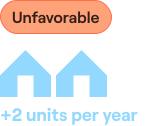
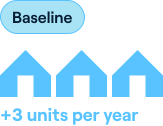
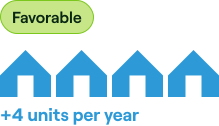
Use the map below to explore how different policies might affect housing development in cities across the country.
Expected units per year
Expected units per year
Expected units per year
Methodology
The Terner Housing Policy Simulator (“Simulator”) is a tool which enables policymakers and researchers to simulate the impact of various policy scenarios on the financial feasibility of housing development.
The Simulator models a comprehensive suite of feasible multifamily developments on a site, the financial viability of each potential development, and the likelihood of development for the most profitable option. Users can then toggle between policy scenarios and compare their potential impact on future development.
The Simulator uses a built-in proforma, a financial projection which estimates the potential profitability of rental projects. It analyzes hypothetical projects, from duplexes to 1,000-unit buildings, which conform to site regulations and user input assumptions across potentially hundreds of thousands of parcels.
This document provides a detailed explanation of the Simulator methodology, including our data sources and the Simulator’s assumptions.
Broadly, the Simulator works as follows:
- For each parcel, the Simulator first conducts a simple and generic building massing to estimate the largest unit count that can fit on each parcel. This maximum unit count is first constrained by physical characteristics of the parcel (lot size, certain existing features limiting developable area), then constrained by local land use and development regulations (e.g., maximum building heights, floor area, density limitations, parking space requirements).
- Next, the Simulator uses its proforma to calculate the type of development (e.g., small multifamily, high-rise apartment building) and corresponding number of units with the strongest financial performance. We call this output the “optimal development.” This calculation uses assumptions (e.g., economic conditions, development timelines, fees, construction costs, operating revenue) that are constant across all simulations but can be adjusted from the baseline settings by the user. This calculation also considers the parameters that users can manipulate from one simulation to the next (i.e., parking inclusion, fee amounts, or zoning allowances).
- The Simulator then estimates the probability that the optimal development might actually be built in the future. This probability is based on a statistical analysis of past development data. This analysis quantifies the relationship between the financial metrics of a potential development (from the Simulator’s proforma) and whether a new multifamily residential building was actually built on a given parcel. Based on these statistical relationships, the Simulator calculates the probability that what it has determined is the optimal development with similar financial metrics will be permitted in the future.
- From there, the Simulator calculates the “expected number of units": the number of units in a parcel’s optimal development multiplied by the associated probability of development. For example, a parcel with an optimal dwelling unit count of 100 and a development probability of 10 percent has an expected number of units of 10. The expected number of units that would be developed citywide is the sum of the expected number of units for all parcels.
Differences in the expected number of units under each policy scenario can result from a combination of two types of changes. First, the optimal development on a parcel could change, resulting in a different number of units. For example, the optimal development for a given parcel might have 10 units for the baseline scenario, but it could increase to 15 units if a larger building would fit if fewer parking spaces were included. Second, the estimated financial metrics and associated probability of development could change. For example, the optimal development for a given parcel might be 10 units for both scenarios, but the probability of development might increase.
Read more about our methodology
The Terner Housing Policy Simulator was developed by Terner Labs. Its analytics are powered by MapCraft.io software. This interactive visualization of some Simulator outputs was designed and built by Graphicacy.
The Terner Housing Policy Simulator has received generous support from Airbnb, Arnold Ventures, Ballmer Group, Coefficient Giving, the Conrad N. Hilton Foundation, JP Morgan Chase & Co, Meta, San Diego Regional Policy Innovation Council, San Francisco Foundation, Sobrato Philanthropies, and the Weingart Foundation.